
Quick Nav
- The Edit Bay Where the Pivot Started
- Challenge: Why Unscripted Speed Did Not Translate Cleanly
- The Skill Gap Audit: What Had to Be Retooled First
- Solution Part One: Training Milestones Built Around Real Scripted Tasks
- Solution Part Two: Mentorship That Translated Habits, Not Identity
- Implementation: Building a Scripted Workflow Beside the Day Job
- Results: What Changed When the Pivot Became Credible
- Lessons for Editors Planning the Same Move
The Edit Bay Where the Pivot Started
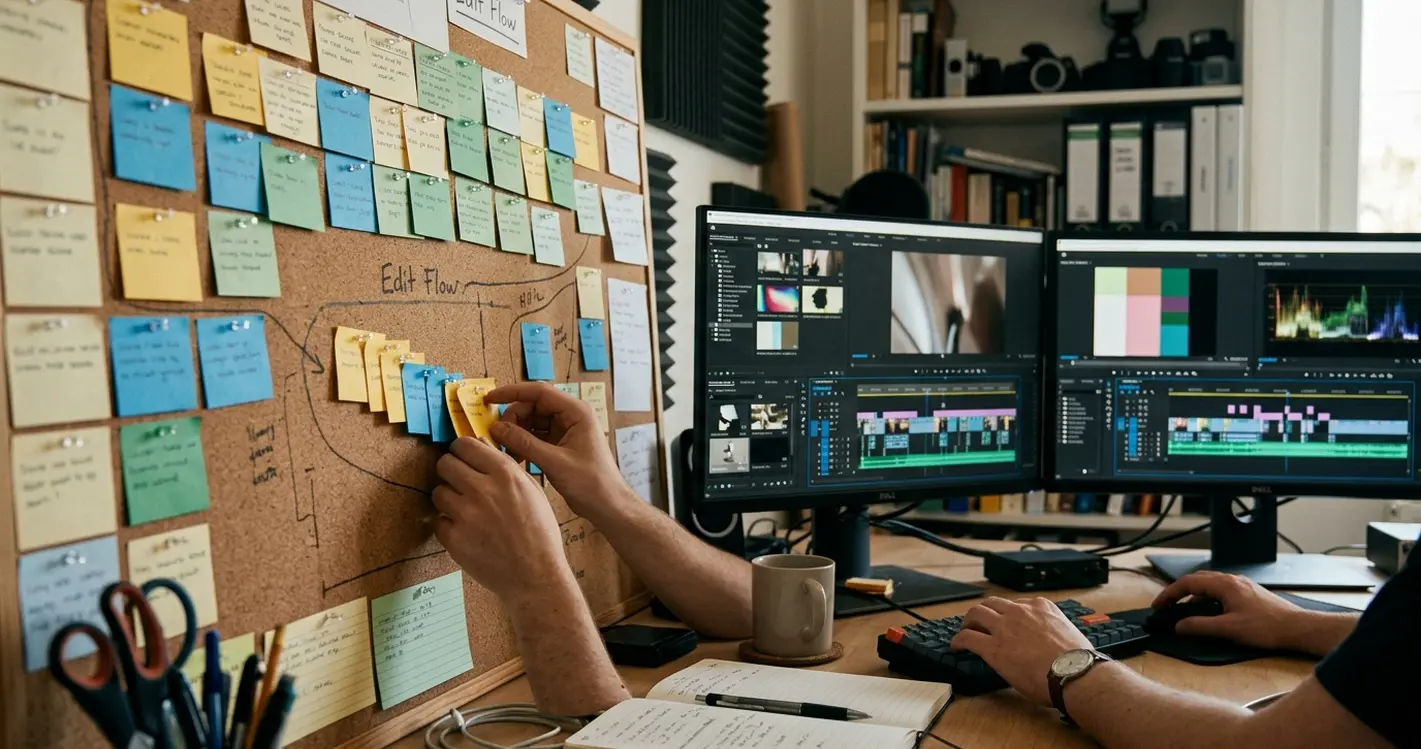
At around 10:15 p.m., the edit bay still had the feel of a room that had already done a full day’s work.
An established unscripted assistant editor, anonymized here to protect privacy, had just wrapped a producer revision pass on a reality episode. The Avid project on screen was familiar territory: interview bins, act breaks, b-roll, grouped clips, revision sequences, and producer notes stacked in a way that made sense under pressure.
Then came the comparison project.
The scripted sample scene looked smaller at first glance, but it asked different questions. Instead of tracking story options across a long reality timeline, the assistant had to read scene number, setup, take, pickup, continuity note, and handoff risk. The late-evening review ran until roughly midnight, not as a heroic all-nighter, but as a useful stress test after normal day-job duties were complete.
The comfort zone was real
The assistant already had speed, resilience, media relinking habits, grouped-clip confidence, and stamina for long episode timelines. None of that was fake. The issue was proof. Scripted television departments do not hire readiness from general toughness alone; they need evidence that an assistant can maintain scripted dailies from intake through mock turnover without turning every handoff into a translation exercise.
Bottom Line: The pivot started when the editor stopped asking, “Can I work hard enough?” and started asking, “Can another person open this project and trust what they see?”
Challenge: Why Unscripted Speed Did Not Translate Cleanly
Unscripted speed did not fail the editor. It simply solved a different problem.
Reality TV often rewards volume control, grouping, producer-facing revisions, fast recovery, and story discovery from messy material. Scripted television puts more weight on script continuity, scene organization, take management, editor-facing clarity, and handoff precision. The two worlds share software and pressure, but not always the same definition of readiness.
Where the friction showed up
- Scene folders that did not yet communicate scene logic cleanly.
- Take labels that worked for the assistant but not for a scripted editor opening the bin cold.
- Script supervisor notes that needed tighter interpretation around pickups, line changes, and continuity flags.
- Dailies review patterns that required faster access to masters, overs, singles, inserts, wild lines, and pickups.
- Temp sound and VFX handoffs that needed clearer status language.
- Mock turnover naming that had to protect sound, color, and online finishing from confusion later.
The assistant’s strengths still mattered: pressure tolerance, media management, revision discipline, and long-form stamina. Hiring hesitation was operational, not personal. Reality credits showed that the editor could survive a demanding post environment, but they did not automatically prove daily readiness for scripted dailies intake, scene maintenance, and turnover support.
A necessary qualifier belongs here: scripted workflows vary by show, editor, studio, post supervisor, delivery path, and crew structure. This case study is about building credible readiness, not declaring one certified room procedure for every scripted department.
The Skill Gap Audit: What Had to Be Retooled First
Before training, the assistant needed an audit. Not a personality audit. Not a vague “strengths and weaknesses” exercise. A workflow audit.

The audit categories
- Editorial software setup: project template, bin views, workspace habits, and sequence handling.
- Project structure: scene folders, dailies areas, turnover areas, and communication bins.
- Dailies intake: logging, labeling, grouping when needed, and status tracking.
- Script-based organization: scene and take naming, script notes, markers, circle-take indicators where applicable, and continuity comments.
- Turnovers: reference exports, sequence copies, labeled folders, and notes for downstream departments.
- Communication etiquette: when to ask, what to document, and what not to silently solve.
The priority was assistant-editor trust, not creative taste. A scripted editor may eventually care whether someone can cut a scene with taste and rhythm, but the first gate is more basic: can this person maintain the room’s working memory?
Inside Avid Media Composer, the work became granular. Bin discipline. Naming conventions. Scene folders. Subclips. Markers. Script notes. Audio track labels. Editor-ready layouts. The assistant tested a naming pattern around scene number, shoot day or date label, coverage type, and status, while stripping out private abbreviations that only made sense to the person who created them.
Field Note: A clever shortcut that requires a verbal explanation is not really a shortcut in a scripted room. It is debt, waiting for the next handoff.
Solution Part One: Training Milestones Built Around Real Scripted Tasks
The training plan worked because it produced inspectable evidence at each stage. No generic course list. No promise that watching more tutorials would magically create department fluency.
Milestone sequence
- Rebuild a scripted scene project. Over a week-and-a-half practice window, the assistant rebuilt a sample scripted scene from organized dailies. The focus stayed on scene folders, setup labels, take order, subclips, and clean bin views.
- Read script supervisor notes against the media. The assistant matched takes to coverage, pickups, line changes, continuity concerns, and print or circle indicators where the sample paperwork included them.
- Create mock turnovers. Sound, color, and online finishing each needed a package: reference exports, sequence copies, labeled turnover folders, and brief notes explaining what was included and what still needed confirmation.
- Cut only after the support work held up. Short scripted scene edits came last, after the bins and handoff package could be understood by someone else without a walkthrough.
That sequence may sound restrained. It was. The point was not to suppress creative ambition; it was to stop creative ambition from arriving before the room could trust the assistant work underneath it.
For software-specific habits, the assistant cross-checked project and bin management decisions against the official Avid Media Composer documentation, especially around projects, bins, bin views, media organization, and sequence management.
Solution Part Two: Mentorship That Translated Habits, Not Identity
What should mentorship correct when the person is already competent?
In this case, it corrected translation errors. The mentor reviewed bins, labels, communication notes, and mock turnover folders. The sessions were not open-ended encouragement. They were focused blocks built around one project package, one bin structure, or one turnover exercise at a time.
Feedback that changed the work
- Labels such as “temp,” “fixed,” or “new version” were replaced with labels that named the scene, take range, purpose, and status.
- Handoff notes were pushed beyond “what changed” into “why this matters” for the editor, sound team, color team, or online finish.
- Unclear script logic became a reason to ask earlier, not a puzzle to solve quietly in isolation.
- Reality-TV speed was reframed as useful only when paired with scripted restraint and repeatable organization.
That last point mattered. In unscripted work, a fast workaround can be a survival skill. In scripted work, a quiet workaround can hide a decision that belongs to the editor, director, or post supervisor. The mentor was not trying to erase the assistant’s background. The work was to preserve the useful pressure habits while removing the assumptions that made the bins harder to trust.
Important: If a handoff note explains the fix but not the risk, the next department still has to guess where to look.
Implementation: Building a Scripted Workflow Beside the Day Job
The assistant did not quit unscripted work to cosplay a new career overnight. The implementation was deliberately conservative.
Practice sat beside the day job across roughly two months of retraining, usually in two evening blocks and one weekend review block when production workload allowed. The repetition was not glamorous. It was template refinement, sample scene rebuilds, checklist passes, and mentor review notes.
The practical toolkit
- A scripted project template with clear dailies, scene, turnover, and communication areas.
- A dailies intake log for scene, setup, take, audio, notes, and status.
- A bin checklist for naming, order, marker use, and editor-ready views.
- A mock turnover checklist covering sound, color, online, references, and sequence copies.
- A communication note template for questions, assumptions, missing items, and confirmation needs.
- A mentor feedback log that tracked recurring corrections instead of treating each note as a one-off.
The portfolio evidence came from the workflow itself: sample bins, documented naming logic, mock handoff notes, sequence copies prepared for turnover, and short explanations of why each choice reduced risk. That last part helped in interviews. The assistant could point to a bin and explain how the structure served an editor, not just claim the setup was clean.
Results: What Changed When the Pivot Became Credible
The result was not a guaranteed job outcome. The change was in the quality of proof.
Interview language moved from broad claims to operational detail. Instead of leading with “I can handle pressure,” the assistant could discuss dailies intake, scene bin structure, script note interpretation, audio labeling, turnover protection, and when a question needed to be escalated.
What became easier to verify
- Sample bins showed scene logic instead of reality stringout support habits.
- Mock handoff documents named what was included, what changed, and what still needed confirmation.
- Script-aware questions showed respect for continuity and decision ownership.
- Mentor feedback shifted from basic structure corrections toward editor preference, continuity judgment, and communication precision.
- The target-role strategy narrowed from “any scripted opportunity” to assistant-editor roles where disciplined support could be demonstrated first.

The pivot became credible when another person could open the sample project, locate a scene, understand the take structure, read the handoff notes, and identify what still needed confirmation. That is a higher bar than sounding adaptable. It is also a fairer one.
Lessons for Editors Planning the Same Move
The larger lesson is blunt: moving from reality television to scripted editing works best as retraining, not rebranding.
Prior experience matters. Speed matters. Pressure tolerance matters. But those strengths have to be translated into the evidence a scripted department can inspect. A polished explanation cannot compensate for bins that still behave like unscripted stringout support.
Scripted Assistant-Editor Readiness Package
- One scripted project template with clear scene, dailies, turnover, and communication areas.
- Scene bins labeled by scene, setup, take range, and status rather than private shorthand.
- A dailies intake log that records what arrived, what is missing, and what needs confirmation.
- Script-aware notes tied to takes, pickups, line changes, and continuity concerns.
- Mock turnover folders for sound, color, and online finishing.
- Short handoff notes that explain decisions in scripted terminology.
The common mistakes are predictable: overselling creative ambition before proving assistant reliability, assuming speed equals readiness, and treating software familiarity as the same thing as department fluency. Some scripted teams expect highly standardized templates. Others depend on editor-specific preferences. The useful skill is disciplined adaptation, not memorizing one rigid bin map.
Bottom Line: If a scripted editor opened your sample project tomorrow, would the bins prove reliability before you said a word?












Your Thoughts
No comments.
Share Your Opinion