

The Tutorial Era Solved Access, Not Mastery
A learner who wants to remap a keyboard command, apply a primary color correction, or export a review file can find a clear lesson in three to eight minutes. That is a genuine achievement. Instruction that was once locked behind expensive classrooms now sits one search away, free or close to it.
But access is not mastery.
Aspiring editors absorb isolated software moves quickly and still stall on the things that actually decide whether a cut works: sequence logic, pacing, troubleshooting, media management, and a clean professional handoff. The button is easy. The judgment about when to press it is not.
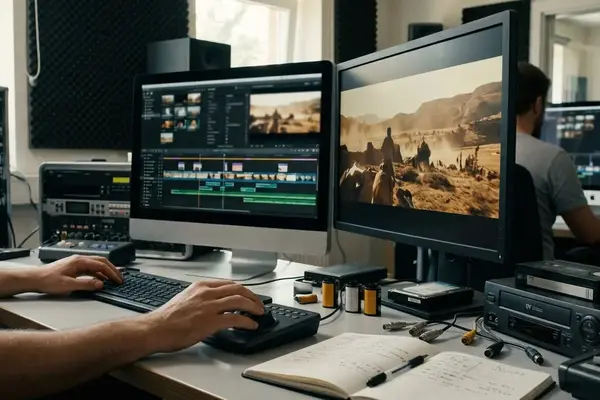
Consider what a supervised short-form edit demands by comparison. It can require several passes across five to ten working days before pacing, organization, audio, and export are all reviewed. The skill being built there moves through a familiar order: ingest, bin structure, selects, assembly, revision notes, sound preparation, finishing, export, archive. Each stage carries assumptions from the one before it.
This is not an argument against tutorials. It is an argument grounded in post-production practice. A timeline can look complete at first playback and still hide mismatched frame rates, unlabeled nested sequences, missing production audio, and export settings pulled from a preset without anyone checking the delivery requirements. Tutorials rarely surface those failures because tutorials rarely show the full chain.
What Tutorials Teach Well—and Where They Stop
Give tutorials their due first. They are fast, searchable, affordable, and excellent at solving a problem you can name. When the question is narrow, the format is close to perfect.
The tasks that fit this shape are specific: remapping a command, applying a primary color pass, toggling a proxy attachment setting, reducing steady background noise, or exporting a client review link. The frame is tight too—one clip, one settings panel, one before-and-after comparison, a lesson short enough to watch between edit passes.
Where the format stops is the decision that came before the demonstration.
A noise-reduction tutorial shows you how to clean a dialogue clip. It does not tell you whether you should replace the line with alternate production audio, shorten the pause, cover the cut with a reaction shot, or simply flag it for the mix stage. The technical move is one of several valid responses, and the tutorial cannot see your sequence.
Here is the trap that makes this concrete. A learner can copy a color correction tutorial successfully on one interview shot, then fail across the full sequence because the camera angles were recorded under mixed light. The fix there is not a single preset. It is shot matching, and shot matching is a judgment problem the tutorial never raised.
The Upstream Question
Every demonstrated step sits downstream of a choice. Tutorials teach the step. They rarely teach the choice, and the choice is usually where editors get stuck.
Editing Is a Chain of Decisions, Not a Bag of Tricks
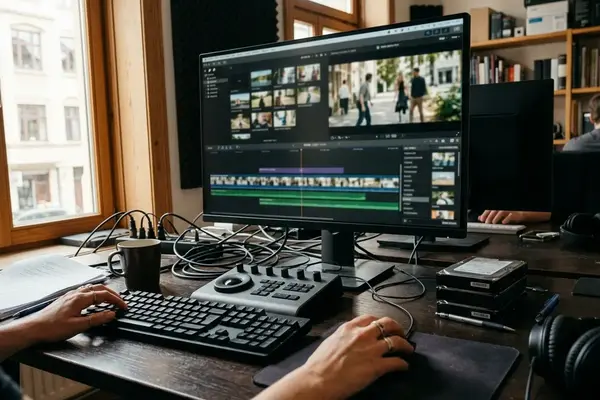
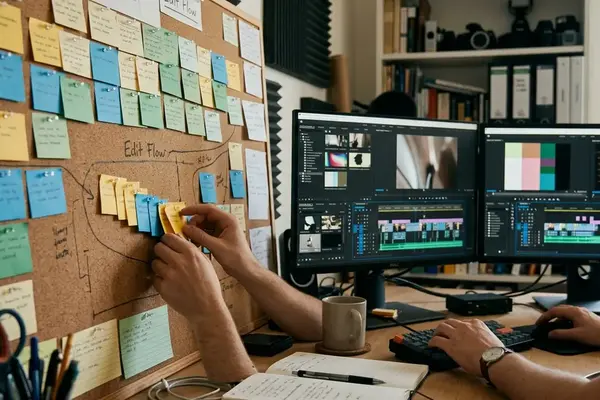
Picture the work as a pipeline rather than a skill list. Ingest feeds organization. Organization feeds selects. Selects feed assembly. Assembly survives revision only if everything underneath it was labeled with care. A mistake made on day one resurfaces on day eight, usually at the worst moment.
An assistant-editor folder pattern makes the dependency visible:
- 01_PROJECT
- 02_MEDIA
- 03_AUDIO
- 04_GRAPHICS
- 05_EXPORTS
- 06_TURNOVER
- 07_ARCHIVE
That structure is not bureaucracy. It is the difference between a targeted pull and a manual hunt. If interviews are labeled only as Clip_001 through Clip_048, a producer note like "use the second answer from the warehouse interview" turns into a search through dozens of files instead of a thirty-second retrieval.
The same logic governs sound. Dialogue prep usually expects clean track separation, room tone kept available, obvious overlaps marked, and temp effects identified before the audio post session begins. Skip that preparation and the mix handoff inherits your mess.

Delivery exposes the chain one last time. A short web piece, a classroom documentary scene, and a broadcast-style segment may each require different export checks even when they were edited in the same software. Structured training teaches why one step precedes another. The bag-of-tricks approach teaches the step and leaves the order to chance.
The Missing Ingredient Is Feedback
What does critique actually change in an edit? Not whether the student likes the cut. Whether the timeline survives notes.
That is the real test, and tutorials cannot administer it. A workable critique cycle runs through rough cut review, written notes returned within roughly one to three days, a revised cut, a technical check, and a final playback on a different monitoring setup than the one used to build it. Each pass reveals a blind spot the editor could not see alone.
Feedback tends to land on the same recurring targets:
- Pacing that drags or rushes around a reaction shot
- Exposed dialogue edits that pop at breath points
- Music covering for weak story structure
- Effects stacked without labels
- Disabled clips left in the timeline with no explanation
Classroom and mentorship constraints sharpen this further. A student might be required to submit a project file, a reference export, a source media map, and a short written rationale for three major edit decisions. The rationale is the point. Professional judgment gets tested when someone asks you to defend why a scene begins on action, why a line was removed, why a jump cut remains visible, or why temp music is driving the structure.
A clean-looking rough cut can collapse during producer revisions when source clips are poorly labeled, music is embedded without alternates, and disabled material sits unexplained. Feedback is what surfaces that fragility before a client does.
The Best Training Does Not Reject Tutorials
The framing of "structured course versus tutorial" is a false binary. The two are tools for different jobs, and the strongest learners run them together.
The ideal model is plain. A course or mentorship supplies sequence, standards, assignments, and critique. Tutorials fill targeted technical gaps inside that frame. One sets the map; the other answers a question along the route.
A workable rhythm looks like this: thirty to sixty minutes of workflow instruction, two to four hours of editing, a tutorial pulled in only when something blocks you, then a review pass against the assignment brief.
Selective tutorial use stays bounded—checking how to relink offline media, confirming a proxy toggle, learning a noise-reduction control, or reviewing export settings for an H.264 client file. The tutorial should answer "how do I attach proxy media?" It should not be asked to answer "what is the cleanest workflow from ingest to final handoff?" That second question belongs to the structure, not the snippet.
A shortcut lesson may speed up solo editing and then breed confusion in a shared project, because raw speed without naming conventions, bin discipline, and version control becomes a liability the moment a second editor opens the file.
What Structured Editing Training Must Include Today
Modern training is not software certification or button-by-button instruction. The bar is professional readiness: repeatable habits around naming, versioning, troubleshooting, collaboration, and review.
A credible curriculum names its territory:
- Media management and assistant editor practices
- Sync, organization, and selects building
- Story structure, pacing, and dialogue editing
- Audio post basics and graphics handoff
- Color preparation and review exports
- Versioning, delivery formats, and archive cleanup
Versioning deserves a concrete shape. Something like project_v01_rough, project_v02_notes, project_v03_mixprep, project_v04_colorprep, project_v05_final, with dated exports stored separately from the working project files. The naming is dull and that is the feature.
Delivery checks carry the same discipline: frame size, frame rate, audio sample rate such as 48 kHz, caption or subtitle needs, head and tail handles for handoff, and a clear answer to whether the file is for review, screening, broadcast-style delivery, or archive.
Reading a Course Honestly
Credibility signals should sit near the curriculum, not in a marketing banner. Look for visible instructor production background, sample assignments, stated review standards, expected weekly workload, project file requirements, and how often lessons are refreshed when tools or delivery norms shift. As a training provider, Video Symphony at 731 N. Hollywood Way operates inside that Los Angeles post-production context, where collaboration is the anchor: assistant-style organization, shared notes, turnover discipline, and clear communication matter because multiple people may touch the same sequence before delivery.
One qualifier worth stating plainly: none of these curriculum markers guarantees a finished editor, since judgment is built across projects, not awarded at the end of a syllabus. The markers raise the odds. They do not replace the reps.
The Practical Takeaway for Self-Taught Editors
This argument does not claim every editor needs the same school, certificate, or classroom format. It claims that editors need some source of sequence, critique, and standards—wherever that comes from.
Disciplined self-taught editors do succeed. The pattern that works tends to share features: one complete project every three to six weeks, a written revision log, a peer critique session, and a final export checked against a delivery sheet. Keep tutorials for immediate blockers, but maintain a structured map covering ingest, organization, edit development, revision, sound, finishing, delivery, and archive.

One caveat on scope. This is aimed at editors moving toward collaborative, client-facing, or professional work. A hobbyist cutting personal clips may reasonably lean on tutorials for much longer, and that is a fine place to be.
Bottom Line: Tutorials answer isolated questions. Structured learning builds the judgment to know which question matters next.



Your Thoughts
No comments.
Share Your Opinion