
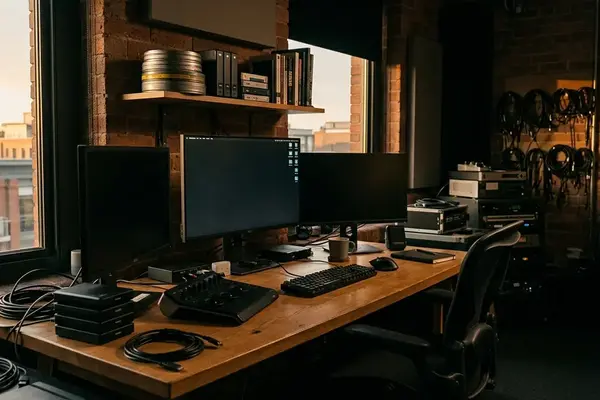
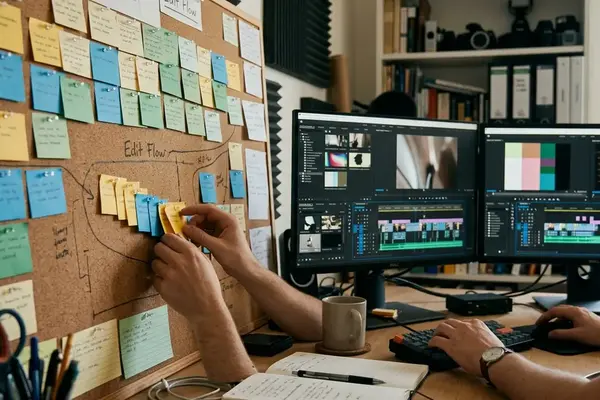

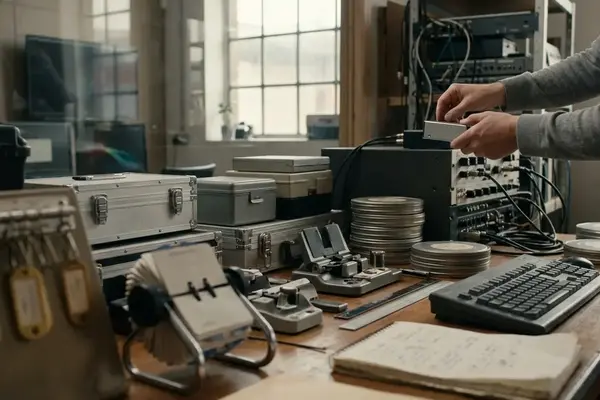
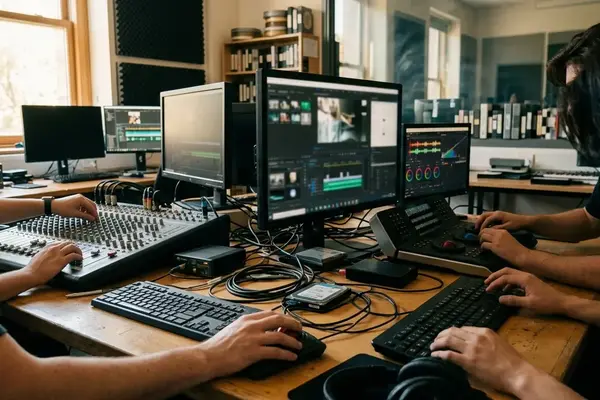
Pro Tools - Pro Tools is a Digital Audio Workstation platform widely used by professionals throughout the audio industries for recording and editing in music production, film scoring, television, post production and video games. The Pro Tools M-Powered system works with M-Audio hardware peripherals, the Pro Tools LE system uses either an Mbox or 003 interface, and the Pro Tools HD hardware includes the Sync I/O, Sync HD, 96 I/O and 192 I/O interfaces. Engineers that learn pro tools become skilled at the most popular audio recording and mixing software used in studios today.audio production - Audio production is all that is required to create and finalize the audio needed for a production. Also called audio digital production, audio post production, audio mixing, audio music production, audio music recording, audio engineering and audio music editing. Contemporary sound recording concepts & techniques often include a blend of vintage sounds with modern editing and mixing automation, to produce the best of both analog and digital audio formats.voice over - A voice over is a spoken message delivered off-camera, often performed in a recording studio. This is the opposite of lip sync recording, done live as the actors are being photographed. An off- screen narration would be considered a voice-over. Voice over recording and production can be found in TV, feature films, radio, music videos, documentaries, commercials, animation, theatre, audio books, broadcast news, sports and video games.backgrounds - Backgrounds are any acoustic environment, such as city traffic, airports, ocean and so on. With its powerful cross fade options, signal processing and automation features; editing backgrounds in Pro Tools can create or save an edit or looping option. recording studio - A facility with rooms created with sound studio designs for specific isolation and acoustic properties for the recording and reproduction of audio. The “studio” is where most of the live sound source recording occurs, and the “control room” is where the playbacks, audio processing and mixing take place. Smaller and/or more specialized studios are called home studios, music studios, mastering studios, voice-over studios, production studios, publishing studios, radio studios, demo studios and midi studios. Recording studio setups and operations along with a complete working knowledge of Digital Audio Recording software are now considered essentials for all 2nd engineers.audio engineering - Audio engineering is a part of audio science dealing with the recording and reproduction of sound through mechanical and electronic means, with analog or digital formats. Job titles for audio engineering include audio engineer, recording engineer, sound engineer, mixing engineer, mixer, live mixer, 2nd engineer, assistant engineer, mastering engineer, audio producer, music producer and audio artist.awards - Awards for Industry recognition that are given by membership based organizations include the Emmy for Television (presented by Academy of Television Arts & Sciences/National Academy of Television Arts & Sciences,) and the Golden Reel Award for Film and Television (presented by the Motion Picture Sound Editors). Awards given for noteworthy sales achievements as certified by the Recording Industry Association of America include the Gold Record (500,000 units), the Platinum Record (1 million units) and the Diamond Record (10 million units).Digidesign - Digidesign is an American digital audio technology company whose flagship software product is Pro Tools. Additional functionality is provided through Pro Tools plug-ins & effects, and plug-ins from many 3rd party developers. The Pro Control, D Command and ICON are control surfaces from Digidesign.pro school - Full-curriculum authorized educational centers for professional level Digidesign Pro Tools sound editing systems.mixing - Within music recording and production, mixing is the processing and balancing of more than one audio source, live or recorded, that are then summed into one or more channels or tracks. Digital audio mixing that is done completely inside a DAW (Digital Audio Workstation), even with occasional analog side chain processing, is often referred to as “mixing within the box”.repeat audit - Students enrolled in Video Symphony's Certificate Programs can re-take classes on an audit basis as a "refresher" for a limited period after the start date of their programs.foley - The background sounds added during audio sweetening to replace missing audio or increase realism. Foley recording, editing & delivery requires understanding what sounds a scene really needs and what materials and/or performance techniques are essential to create such sounds. The Foley editor works with the Foley artists to create the sounds, and often with the director and mixer on the final mix.sound effects - Within audio production and especially those containing video content, sound effects generally are considered all audio that is not voice or music, and sound design and Foley are a part of sound effects. Within audio processing and mixing, sound effects or simply “effects” usually means signal processing; such as reverb, delays, flanging and so on, as in the phrase “add an effect”.surround sound - A multi channel audio format that involves a mix of three or more channels, to provide a more immersive listening experience. The most common format is 5.1 (5 satellite speakers plus a subwoofer) but 7.1 (7 satellite speakers plus a subwoofer) is gaining ground in Home Entertainment, especially with video games. The .1 indicates the reduced bandwidth of the LFE channel. Increased bandwidth options, newer codecs and the emergence of BluRay allow audio delivery in Surround Sound to be discreet to each channel, whereas in the past some encoding formats offered a matrixed delivery.job-centric - In the educational sense, job-centric signifies practical training that focuses on the array of skills and knowledge that will be essential in the entertainment post-production industry. adr - Automated dialogue replacement or additional dialogue recording (ADR) is a film sound technique involving the re-recording of dialogue after photography that can be applied in film, TV, commercials and video games. ADR is used to replace undesirable production audio, to enhance the sound, to change the quality of a performance delivery, or to separate the voice from other sound elements for greater control of its volume, localization or spatial quality with a mix.Video Symphony - Burbank, CA school providing professional quality training in digital media production.